A Rechargeable Fan is a portable cooling device powered by an internal battery. Unlike a traditional plug-in fan, it can operate without a wall outlet. This makes it useful during travel, outdoor work, power interruptions, or warm nights beside a bed. The design is simple, though not flawless.
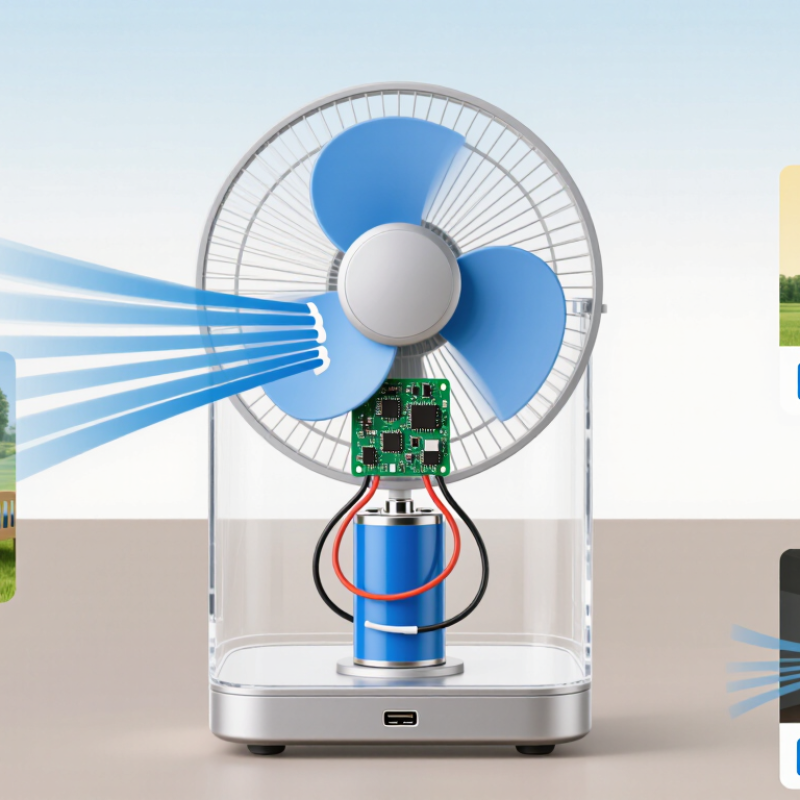
Inside the housing, a rechargeable battery sends controlled electrical current to a small motor. The motor rotates the blades, which push air forward and create a cooling breeze. A circuit board manages speed settings, charging, and battery protection. Many models use lithium-ion cells and charge through USB-C. Actual runtime depends on battery capacity, fan speed, lighting features, and battery age. Higher airflow usually consumes power faster.
Small details matter.
A reliable evaluation should examine more than advertised runtime. Check the charging indicator, grille stability, noise level, airflow range, and heat around the motor. The manufacturer’s manual remains the best source for charging limits and maintenance instructions. Independent testing can also reveal differences between laboratory claims and everyday performance. Some fans remain effective for hours, while others weaken sooner than expected. That variation deserves attention.
This article explains how a Rechargeable Fan works, from stored electrical energy to moving air. It also considers battery care, operating safety, charging habits, and practical limitations. A fan cannot lower room temperature like an air conditioner. It mainly improves comfort by moving air across the skin. Understanding that difference helps buyers choose a suitable model and use it with realistic expectations.
A rechargeable fan is a portable airflow device powered by an internal battery. Its motor converts stored electrical energy into rotating blade movement. The blades push air across the skin, creating a cooling sensation without lowering room temperature. The U.S. Department of Energy explains that fans mainly improve personal comfort, rather than cooling an entire space.
Key features include multiple speed settings, a charging indicator, oscillation, a timer, and a protective grille. Many models also support low-voltage charging through a cable.
Very portable.
Battery capacity is usually measured in watt-hours, while operating time depends on power consumption. A simple estimate is runtime equals battery watt-hours divided by fan watts.
For example, a 20-watt-hour battery may theoretically power a 5-watt setting for four hours. Real results are lower because of motor losses and battery protection systems.
IEA’s report The Future of Cooling projects that global space-cooling demand could triple by 2050, increasing interest in efficient personal airflow. However, runtime labels deserve careful review.
Testing conditions vary, and maximum-speed figures may not represent daily use.
I would check measured noise, recharge time, airflow distance, and battery replacement options before purchase. A quieter fan can feel more useful at night, even when its airflow is modest.
What Is a Rechargeable Fan and How Does It Work?
Key Components Inside a Rechargeable Fan
A rechargeable fan stores electrical energy in a lithium-ion battery pack. The battery management system monitors voltage, temperature, and charging current. It prevents unsafe overcharging and deep discharge. The International Energy Agency reported a 14% fall in lithium-ion battery pack prices during 2023. That decline supports more affordable portable appliances, although fan batteries remain highly variable.
Inside the housing, a brushless DC motor converts battery power into rotation. Its electronic controller switches current through internal coils. The rotor then turns the blades, creating airflow through the front grille. A printed circuit board manages speed buttons, charging input, indicator lights, and sometimes oscillation. I have found that loose connectors often cause intermittent speed changes. Small details matter.
The fan’s battery capacity is measured in watt-hours, not only milliamp-hours. A 20 Wh battery may power a low setting longer than a 10 Wh pack. Actual runtime depends on motor load, blade design, and airflow resistance. The U.S. Department of Energy’s fan-system research shows that airflow demand strongly affects power consumption. This principle applies here, too. However, laboratory figures can disappoint in dusty rooms. Filters clog, bearings wear, and heat reduces battery performance. Rechargeable fans are simple devices, but their efficiency depends on every component working together.
A rechargeable fan stores electrical energy in a lithium-ion battery and uses a motor, charging circuit, battery-management system, speed controller, and fan blades to produce airflow.
The chart uses nominal lithium-ion voltage of 3.7 V, an estimated usable-energy efficiency of 85%, and an 8 W fan load. Estimated runtime is calculated as battery capacity × 3.7 V × 85% ÷ 8 W. Actual runtime varies with speed, motor efficiency, battery age, and airflow resistance.
A rechargeable fan creates airflow by turning stored electrical energy into spinning motion. Its lithium-ion battery sends direct current to a compact DC motor. The motor rotates a central shaft, which turns several angled blades. As the blades spin, they push nearby air forward and create a lower-pressure area behind them. Air then moves continuously through the rear grille and across the room.
The blade angle matters. Steeper blades can move more air, but they usually require more power and may produce extra noise. A front grille helps guide the airflow and protects fingers from the moving blades. Speed controls change the motor’s electrical input, so low settings provide a gentler breeze while using less battery. Higher settings feel stronger, but they drain the battery faster. No outlet is needed.
In practical use, airflow can feel uneven if the fan sits too close to a wall or faces a large obstacle. Dust on the grille may also reduce circulation and make the motor work harder. I have found that a slightly raised position spreads air more effectively than floor-level placement. Still, rechargeable fans have limits. Their airflow is often weaker than larger powered fans, and battery performance can decline over time. The exact runtime depends on battery capacity, motor efficiency, speed setting, and charging conditions. Some specifications seem precise, but real room temperature and airflow can change the result.
A rechargeable fan stores electrical energy in a built-in battery, usually a lithium-ion pack. The battery supplies direct current to a motor through a control circuit. When the motor receives power, its coils create magnetic forces that turn the rotor and fan blades. Air moves because the rotating blades create a pressure difference. Simple, but not effortless.
Battery capacity is measured in watt-hours. A 3.7-volt battery rated at 4,000 mAh stores about 14.8 watt-hours before losses. If the fan draws 5 watts, the theoretical runtime is nearly three hours. Real runtime is shorter.
Speed settings, motor efficiency, battery age, and heat all change the result. A high-speed setting uses more current. The battery also loses energy through the circuit and charging process.
Charging reverses the process. A USB power source sends current into the fan’s charging circuit, which controls voltage and current before reaching the battery cells. Many systems use constant-current and constant-voltage charging, then reduce current near full capacity. The International Energy Agency reported that lithium-ion battery demand reached about 750 GWh in 2023, showing how widely this battery chemistry is used. BloombergNEF’s 2023 Battery Price Survey also placed average battery-pack prices at 139 dollars per kWh, a 14% annual decrease. These figures describe the wider battery industry, not every fan. A fan’s advertised runtime may still feel optimistic. Check the input rating, charging time, and airflow at each speed.
A rechargeable fan stores electrical energy in a built-in battery and sends it to a small motor. The motor turns the blades, creating moving air across the skin. A charging circuit restores the battery through a cable or adapter. Many models offer several speed levels, though higher speeds drain power faster. Airflow cools people by helping sweat evaporate. It does not lower room temperature like an air conditioner.
Common types include handheld, desktop, clip-on, neck-mounted, and pedestal fans. Handheld fans suit commuting, outdoor queues, and short walks. Desktop fans work well beside a laptop or bed. Clip-on models attach to shelves, strollers, or workbenches. Neck-mounted fans keep both hands free, but their airflow may feel uneven. Pedestal fans cover a larger area and usually provide stronger circulation. Some designs also include LED lights, timers, or emergency charging ports.
Practical use depends on battery capacity, noise, and stability. A fan with a weak base may tip on a crowded desk. A compact model can fit a bag but may require frequent charging. Check the charging indicator before leaving home. Keep fingers, hair, and loose fabric away from exposed blades. Dust also reduces airflow over time, so clean the grille regularly. In humid weather, the cooling effect can feel limited. That is an easy detail to overlook. A rechargeable fan is useful, but it cannot replace ventilation in a hot, poorly aired room.
| Fan Type | How It Works | Typical Battery Runtime | Typical Charging Method | Airflow and Speed Control | Practical Uses | Main Advantages | Important Considerations |
|---|---|---|---|---|---|---|---|
| Handheld Fan | A small rechargeable battery powers a compact DC motor that rotates the fan blades. Airflow is directed manually by holding and aiming the unit. | Approximately 2–12 hours, depending on speed, battery capacity, and lighting features. | Usually charged through USB-C or another USB connection; charging commonly takes about 2–5 hours. | Usually 2–5 speed levels; airflow is concentrated over a relatively small area. | Personal cooling while commuting, traveling, waiting outdoors, or working at a desk. | Lightweight, portable, easy to store, and generally inexpensive to operate. | Limited cooling area and shorter runtime at the highest speed; small blades may produce less airflow than larger fans. |
| Desktop Fan | The internal rechargeable battery supplies power to a motor and blade assembly mounted in a compact stand for use on a flat surface. | Approximately 3–20 hours, depending on fan size, speed, and battery capacity. | USB-C or USB charging is common; some models can operate while connected to a power source. | Typically 3–6 speeds, with some models offering oscillation or adjustable tilt. | Office desks, bedside tables, study areas, reception counters, and small personal workspaces. | Hands-free operation, stable placement, and a better balance between portability and airflow. | Requires a reasonably level surface; small models may not circulate air effectively throughout a large room. |
| Clip-On Fan | A rechargeable motor drives the blades while a spring-loaded clip attaches the fan to a desk edge, shelf, bed frame, stroller, or other suitable surface. | Approximately 3–16 hours, depending on speed and battery capacity. | Generally charged through USB-C or USB; charging time is commonly about 2–5 hours. | Usually 3–5 speed levels; the fan head often tilts vertically, and some models oscillate. | Bunk beds, office partitions, nursery areas, camping shelters, wheelchairs, and compact workspaces. | Saves desk space and can direct airflow from an elevated or unusual position. | Clips must be attached securely; unsuitable surfaces can cause vibration, slipping, or accidental falls. |
| Neck Fan | Two small motorized fan units rest around the neck and direct airflow toward the face and neck without requiring hand support. | Approximately 2–10 hours, depending on speed and design. | Usually charged through USB-C or USB; higher-speed settings require more frequent charging. | Commonly 2–4 speed levels; airflow direction is limited by the position of the wearable unit. | Walking, gardening, light outdoor work, festivals, travel, and other situations where both hands are occupied. | Hands-free, highly portable, and useful during light activity. | Airflow is close to the face and may feel less effective in very hot or humid conditions; hair and loose clothing should be kept away from moving parts. |
| Pedestal or Floor Fan | A larger motor and blade assembly are powered by a rechargeable battery and mounted on an adjustable stand for broader room airflow. | Approximately 3–24 hours, depending on blade size, speed, oscillation, and battery capacity. | Often charged from an AC adapter; some models also support USB or removable battery charging. | Typically 3–8 speeds, with adjustable height, tilt, and oscillation on many designs. | Bedrooms, living rooms, temporary work areas, power outages, outdoor events, and semi-open spaces. | Moves more air over a larger area than handheld or small desktop fans. | Heavier and less portable; maximum airflow can drain the battery quickly, and the stand requires storage space. |
| Camping or Outdoor Fan | A rechargeable battery powers a fan designed for outdoor use, often with a protective grille, sturdy base, hanging hook, or integrated light. | Approximately 4–40 hours for airflow; integrated lights and high-speed operation can reduce runtime. | USB-C, USB, or an AC adapter may be used. Some units can be recharged from a power bank or compatible solar charging system. | Usually 2–5 speeds; some models provide adjustable tilt, hanging positions, or multiple operating modes. | Tents, patios, emergency kits, picnics, workshops, vehicles, and temporary outdoor shelters. | Portable, versatile, and useful where mains electricity is unavailable. | Outdoor protection varies by model; the fan should be kept away from rain and standing water unless it is specifically rated for wet conditions. |
| Misting Fan | The rechargeable fan moves air while a small water reservoir supplies fine droplets that can enhance perceived cooling in dry environments. | Approximately 2–10 hours of fan operation; misting time is limited by reservoir size and water flow. | Usually charged through USB-C or USB; the water reservoir must be filled separately. | Commonly 2–4 fan speeds with one or more misting settings. | Outdoor queues, patios, sporting events, travel, and personal cooling in dry weather. | Combines airflow with evaporative cooling and remains portable. | Works less effectively in humid conditions; the reservoir should be emptied and cleaned regularly to reduce odor and buildup. |